
Noise from production machinery, material handling, compressed air, fabrication equipment, and maintenance activities can become part of the normal background of a manufacturing facility. Monitoring helps determine which employees, tasks, and areas require attention.
Noise assessments combine area sound level measurements and employee dosimetry to identify high-noise tasks, areas, and employee exposure patterns.
Noise is one of the most common occupational hazards in manufacturing environments. Production machinery, compressed air, material handling, fabrication equipment, conveyors, saws, grinders, presses, compressors, mobile equipment, and maintenance activities can all contribute to employee exposure.
Because noise becomes part of the normal background of a facility, excessive exposure can sometimes be overlooked. A workplace noise assessment helps determine where elevated noise exists, which employees may be affected, and whether additional controls or a hearing conservation program may be required.
High occupational noise exposure can contribute to permanent hearing loss over time. Unlike many workplace injuries, noise-induced hearing loss may develop gradually, and employees may not immediately recognize that their hearing is being affected.
OSHA’s general-industry noise standard requires employers to implement a continuing, effective hearing conservation program when employee exposure equals or exceeds an 8-hour time-weighted average of 85 dBA. Monitoring is required when information indicates that employee exposure may reach or exceed that level.
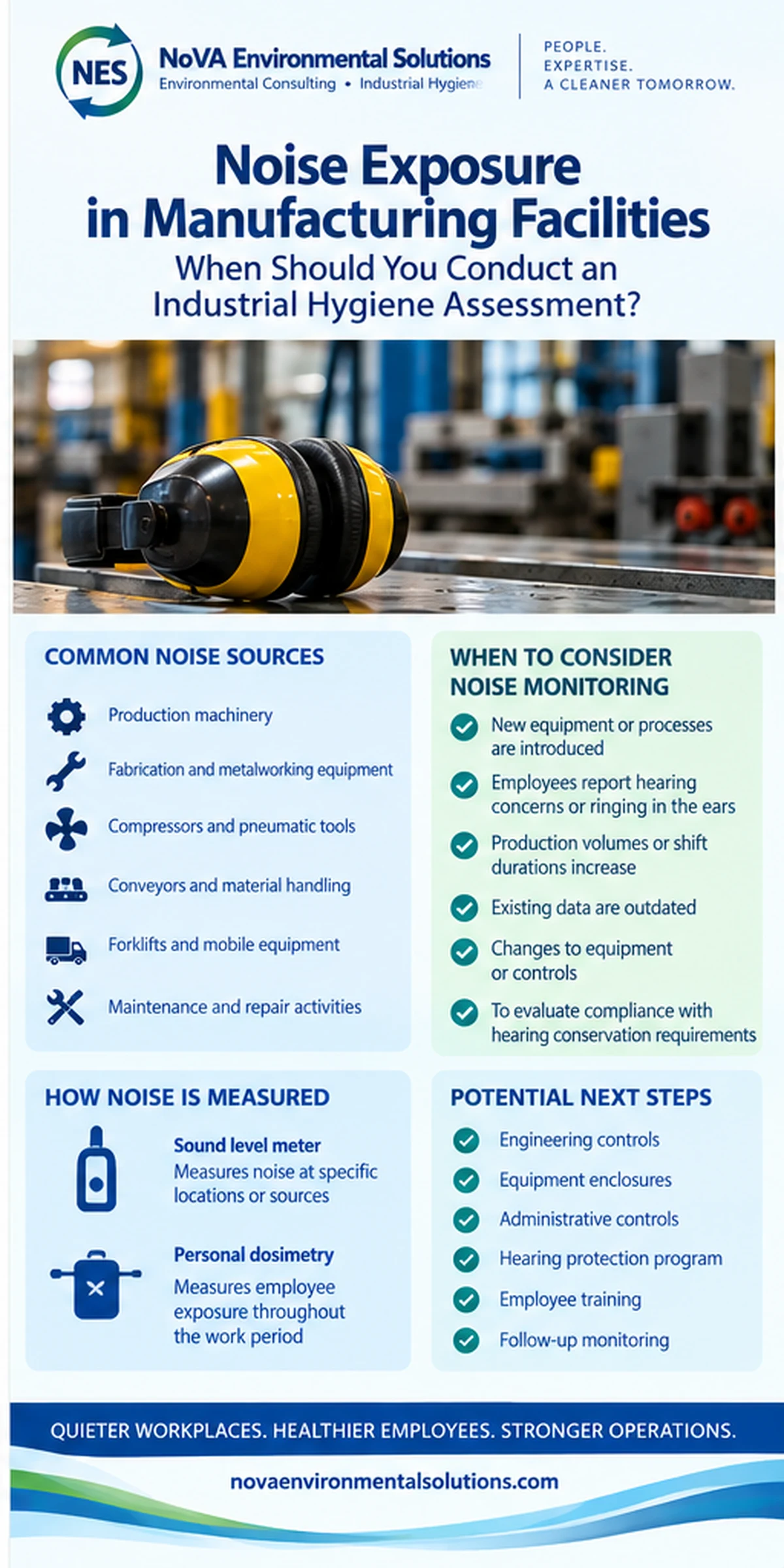
Industrial hygiene noise assessments typically use two complementary approaches. A sound level meter measures noise at a particular location or from a particular source. These measurements can help identify loud equipment, high-noise production areas, tasks producing elevated sound levels, and locations where engineering controls may be useful.
A personal noise dosimeter is worn by an employee and measures exposure throughout the work period. Dosimetry is particularly valuable when employees move between multiple areas, perform a variety of tasks, or experience changing noise levels during the shift.
Noise exposure can vary by job, task, location, and duration. A well-designed assessment evaluates both the sources of noise and the exposure experienced by employees.
Noise monitoring may be appropriate when employees have to raise their voices to communicate nearby, new machinery or processes are installed, employees report ringing in the ears or hearing concerns, existing monitoring is outdated, work shifts or production durations increase, employees move among multiple noisy areas, engineering controls are modified, or management is evaluating hearing-conservation requirements.
Monitoring can also establish baseline data that can be compared with future operating conditions. This is particularly useful for facilities that expect equipment, process, or production changes.
A manufacturing floor may contain several sources producing similar noise levels, but employee exposure depends heavily on where employees work and how long they remain there. A maintenance employee who moves throughout the facility may have a very different exposure profile from a machine operator stationed at one production line.
That is why representative employee groups and tasks should be considered when designing the monitoring strategy. A sound-level map alone may identify noisy areas but will not necessarily establish an employee’s full-shift exposure.
Noise-monitoring data can help determine whether additional actions are warranted. Depending on the findings, facilities may consider engineering noise controls, equipment enclosures, maintenance or equipment modifications, administrative controls, hearing protection, employee training, hearing conservation program measures, or additional monitoring.
The goal is to understand both the magnitude of the exposure and where the exposure is occurring so that resources can be directed toward the most meaningful controls.
A well-planned assessment can usually be conducted while normal manufacturing activities continue. In fact, monitoring during representative normal operations is important because the objective is to understand what employees experience during their actual workday.
Before sampling, NES works with facility representatives to understand processes, job classifications, schedules, materials, and potential exposure concerns so that monitoring can be targeted appropriately.
NoVA Environmental Solutions supports industrial and manufacturing clients with workplace noise surveys, personal noise dosimetry, industrial hygiene investigations, occupational exposure evaluations, data interpretation, technical reporting, and recommendations based on observed operating conditions.
An effective industrial hygiene assessment gives facility management defensible information that can be used to protect employees, prioritize controls, and make informed operational decisions.
For current regulatory requirements and guidance, see OSHA’s Occupational Noise Exposure standard (29 CFR 1910.95) and OSHA’s Occupational Noise Exposure resources.