
Per- and polyfluoroalkyl substances—better known as PFAS—have become one of the most closely watched groups of emerging environmental contaminants in the United States.
For property owners, municipalities, facilities, developers, and organizations responsible for drinking water, PFAS is increasingly becoming part of the water quality conversation.
What Are PFAS?
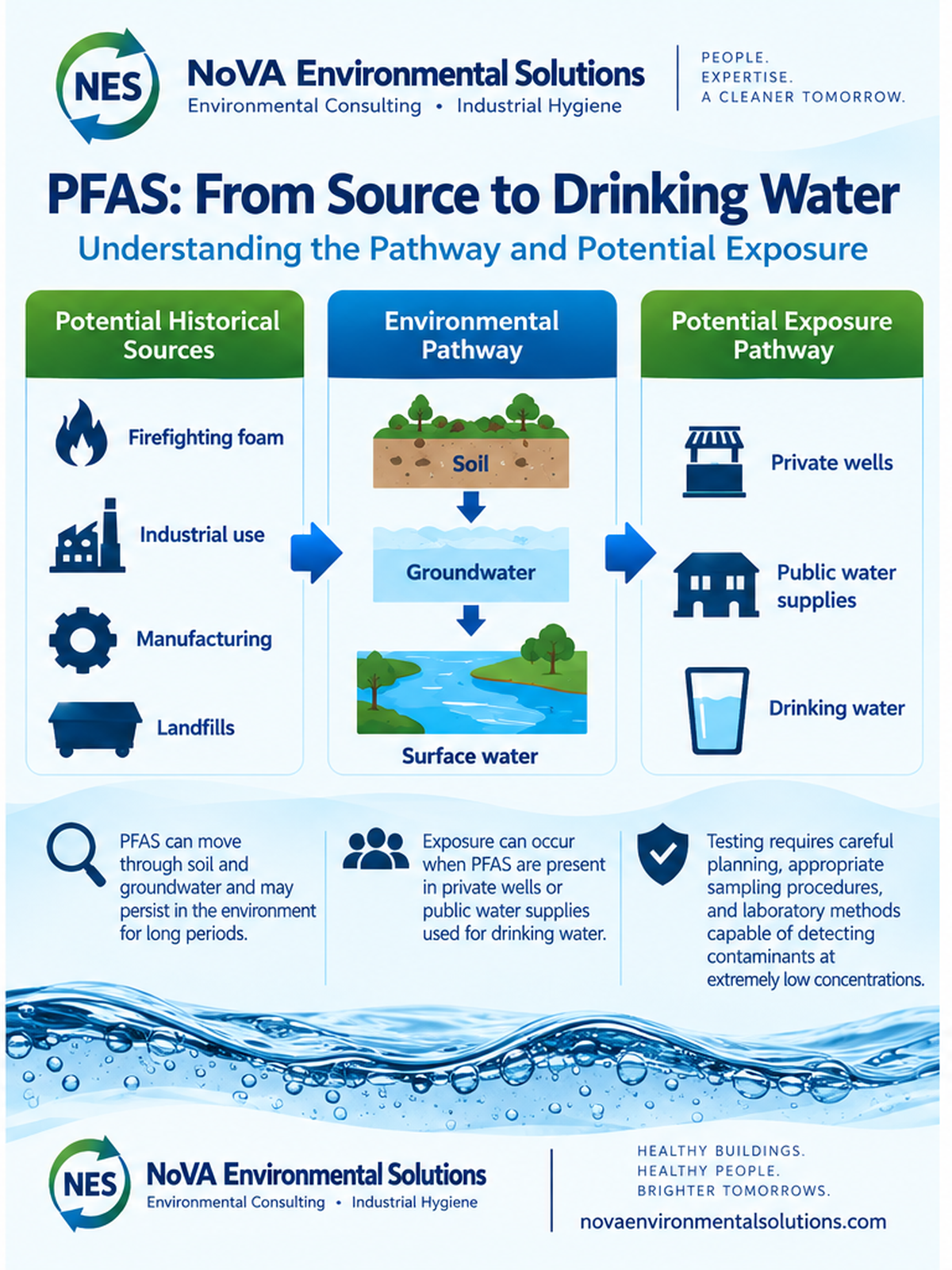
PFAS are a large group of synthetic chemicals that have been used for decades because of properties such as resistance to heat, water, oil, and stains. They have historically been associated with certain firefighting foams, stain- and water-resistant products, food packaging, industrial coatings, and a variety of manufacturing processes.
One reason PFAS receive significant attention is their persistence. Certain PFAS can migrate through soil and groundwater and may remain in the environment for extended periods.
Why Is Drinking Water Receiving So Much Attention?
Drinking water can become a pathway for PFAS exposure when groundwater or surface-water supplies are affected by PFAS releases. Potential source areas can include locations associated with historical industrial activity, firefighting foam use, landfills, airports, military facilities, and other operations.
PFAS contamination does not necessarily mean that a current property owner caused the problem. In some locations, impacts may be associated with historical activities or originate some distance from the property being evaluated.
Federal Drinking Water Standards: Where Things Stand in 2026
EPA’s 2024 National Primary Drinking Water Regulation established enforceable drinking-water limits for several PFAS. As of September 2026, EPA is maintaining the federal Maximum Contaminant Levels of 4.0 parts per trillion for PFOA and 4.0 parts per trillion for PFOS.
In May 2026, EPA proposed a framework under which qualifying public water systems could receive two additional years—until 2031—to comply with the PFOA and PFOS limits. EPA also proposed rescinding the regulatory determinations and associated drinking-water regulations for PFHxS, PFNA, HFPO-DA (commonly known as GenX chemicals), and the Hazard Index mixture that includes those three PFAS and PFBS.
Those 2026 actions remain proposed rulemakings as of September 2026. Because the regulatory landscape continues to evolve, organizations should verify current federal and applicable state requirements when making compliance decisions.
PFAS Testing Requires Careful Planning
PFAS sampling is not the same as routine drinking-water sampling. Because PFAS can be present in many materials and products, proper sampling procedures and quality-control measures are particularly important.
A sampling program should consider why testing is being performed, the water source, appropriate sampling locations, applicable regulatory or investigative objectives, laboratory analytical methods, quality assurance and quality control, potential cross-contamination during sampling, and how results will be interpreted and reported.
Testing without a clear objective can result in data that are difficult to interpret or apply.
PFAS Is Part of a Bigger Emerging-Contaminant Discussion
PFAS is receiving significant regulatory attention, but it is not the only emerging water quality concern. EPA, states, laboratories, and the scientific community continue evaluating additional contaminants that may become increasingly important to drinking-water management, including substances such as pharmaceuticals, personal-care-product compounds, and microplastics.
For building owners and facility managers, this means the definition of water quality continues to evolve as analytical methods become capable of detecting contaminants at increasingly low concentrations.
What Should Property Owners and Facility Managers Do?
Not every building needs independent PFAS testing. Organizations should first consider the source of their drinking water. A facility supplied by a regulated public water system may already have PFAS monitoring information available through the utility, while properties relying on private wells or other independent sources may require a different evaluation.
Testing may also become relevant during environmental investigations, due diligence, redevelopment projects, source-water evaluations, or when historical property uses suggest the potential for PFAS impacts. The important first step is defining the question that needs to be answered.
How NoVA Environmental Solutions Can Help
NoVA Environmental Solutions assists clients with environmental sampling and water quality investigations throughout the region. Depending on project needs, services may include drinking-water sampling, PFAS sampling coordination, environmental site investigations, water quality assessments, sampling-plan development, laboratory coordination, review of analytical results, and investigation of potential contaminant sources.
PFAS regulation and environmental science continue to evolve. Organizations do not necessarily need to test for every emerging contaminant, but they should understand when an emerging contaminant may be relevant to their facility, property, or environmental investigation.
A well-designed assessment starts by identifying the question, selecting the appropriate analytical approach, and collecting defensible data that can support an informed decision.